
A DIGITALLY EMPOWERED BANK
DIGITAL
EXCELLENCE
Customer
convenience and
accessibility
Process and
infrastructure
development
Strengthening
security
PRIORITY
AREAS
STRATEGIC
PILLAR
SDGs
IMPACTED
MATERIAL
TOPICS
M1
M2
1,490
digital contact
points
19%
Virtually enabled
customers
46%
Digital transactions
11%
Increase in
digital adoption
CONTEXT FOR 2023
LKR 1.4
billion
Invested in
Digitalisation
34%
Digitally enabled
customers
•
The economic crisis led customers and employees to face
challenges with respect to mobility and accessibility.
•
A greater focus on resource efficiency and sustainability owing to
resource shortages and climate change.
•
With the rise in digitalisation across society, threats to cybersecurity
remain a key concern across organisations, particularly those with
access to sensitive information.
•
An increased need for productivity and automation amid the
increase in employee migration.
Digital transformation is an
ongoing process at Bank
of Ceylon, and deeply
entrenched within our
operations and approach
to doing business. Our
digital capabilities enable
us to achieve wide-ranging
outcomes by delivering
convenience and accessibility
to our customers, while
driving increased efficiency,
productivity and responsible
consumption.
Digital
Onboarding
in 2023
976,894
Card Users
463,084
Smart
Passbook
Holders
425,700
Smart Online
Banking Users
352,727
Smart Pay Users
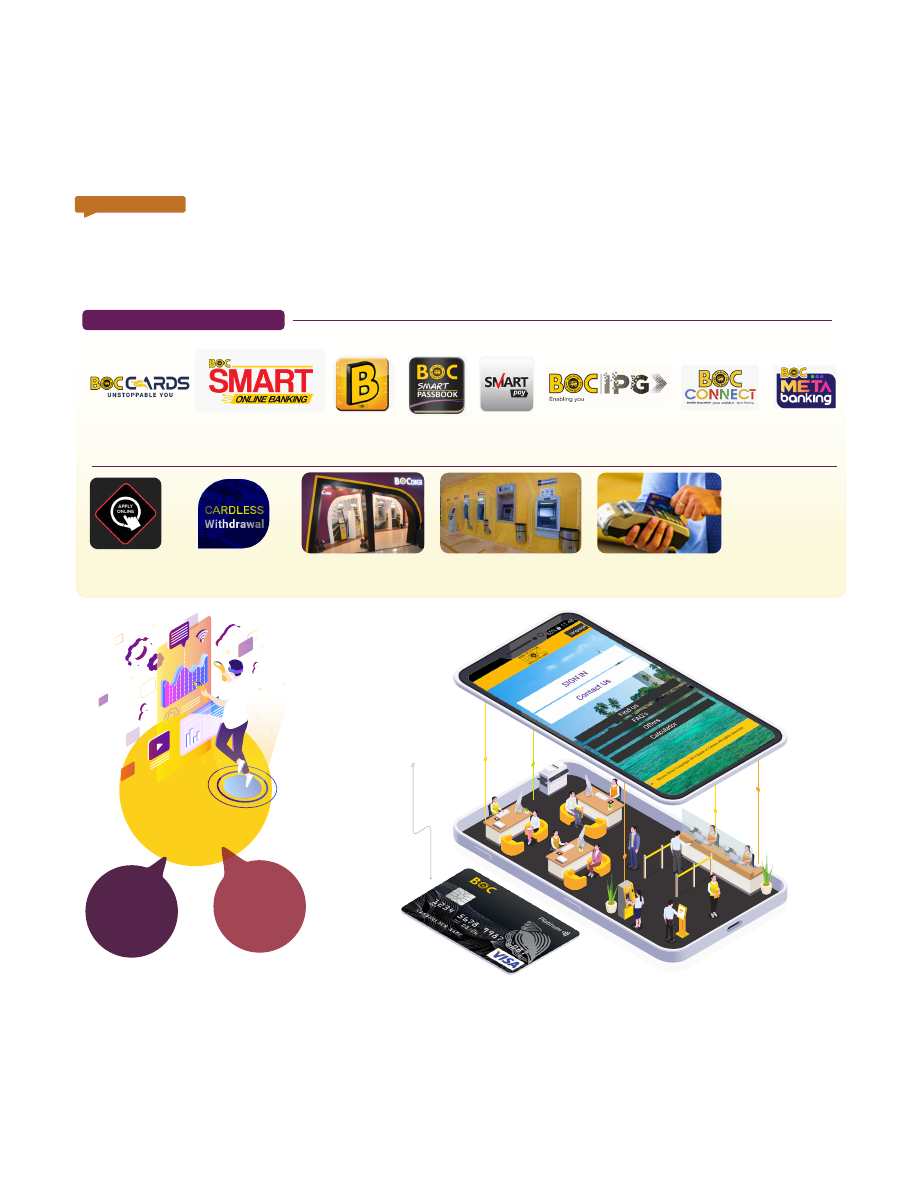
Digital products and Services
Online Banking
platform
International
payment gateway
Agency Banking
WhatsApp
Banking
Mobile
Banking
app
Digital Pass
Book
Digital fund
transferring
Online apply
via web
Cardless
Withdrawal
Self service
banking
Smart
zones
POS terminal
PRIORITY AREA 01:
CUSTOMER CONVENIENCE AND ACCESSIBILITY
BoC relies on a versatile range of digital channels and platforms to ensure its customers are able to access key banking functions from
any location, at any time, with the added benefit of maximising the Bank’s reach across the island.
An Improved
Customer
Experience
Enhancing
Existing
Channels
Enhancing Existing Channels
The Bank engaged in upgrading and
improving its channels and platforms to
ensure its customers receive a seamless,
integrated and convenient experience
across every digital interaction.
During the year under review, the
Bank successfully revamped the BoC
SmartPay app to improve the overall
user experience and took further steps
to initiate the process of revamping the
Bank’s mobile application and internet
banking application. The Bank further
expanded its digital touchpoints during
the year under review.
New Channel
Development
BoC Cards
100
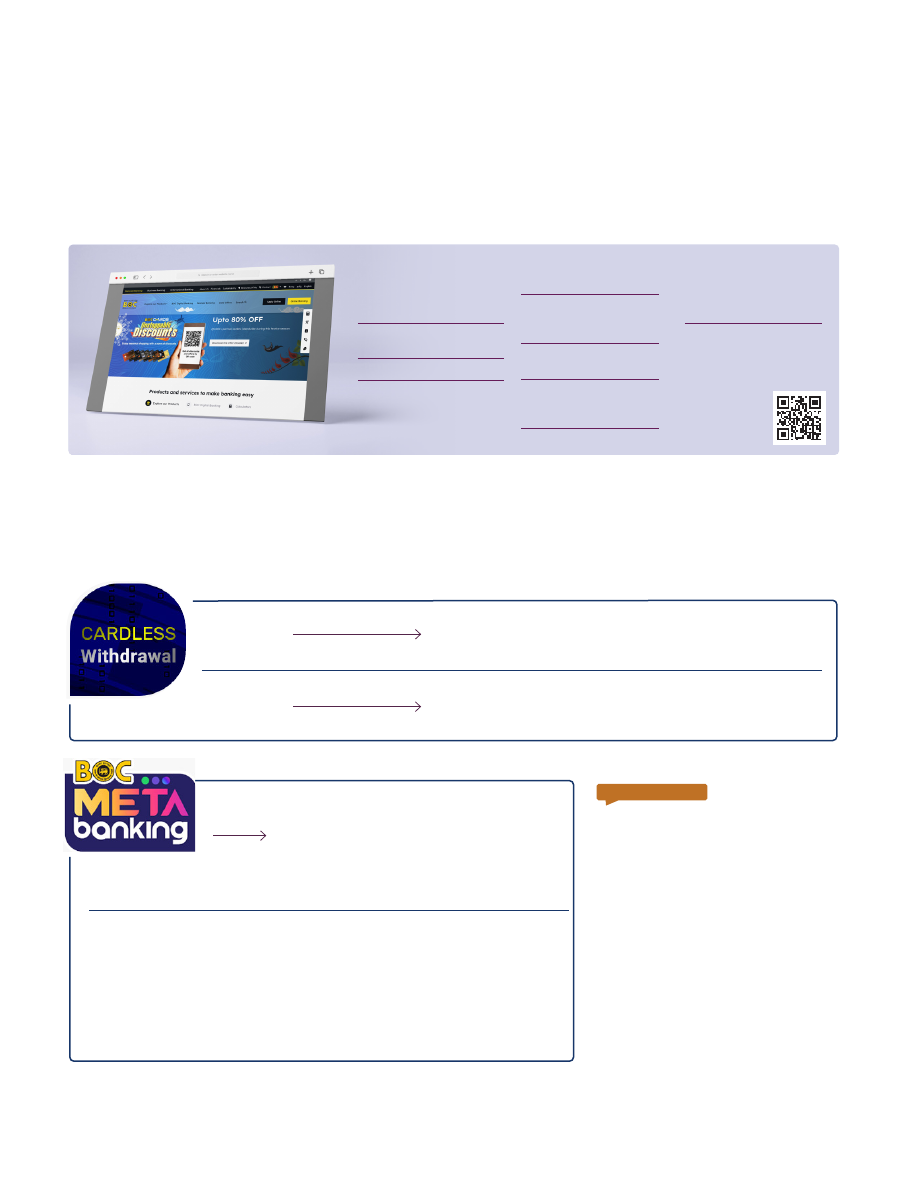
The Bank’s website act as 24/7 digital storefront for its vast customer-base from any location. The website was revamped and
launched during 2023, and includes the following features:
•
An enhanced interface and
significant improvements
in the presentation of
information
•
Available in Tri-lingual
(English/ Sinhala/ Tamil)
•
High mobile responsiveness
•
Accessibility features to
facilitate the needs of the
differently-abled aligned
with CBSL and UN SDGs
guidelines
•
Products and services
linked to the home page to
improve accessibility
•
Locally thematic design
and appearance
•
Branch network/customer
touchpoints integrated
with Google Maps
•
Interest rate calculation
for loans and deposit
build-up through a newly-
introduced calculator
•
A separate page arranged
for 'BoC Museum' with
online reservation forms for
museum visits
www.boc.lk
A DIGITALLY EMPOWERED BANK
New Channel Development
The Bank continues to take a pioneering role in introducing new developments to the market, and relies on the combined strength
of its Innovation Lab, Product Development and Business Process Re-engineering Project (BPRP), in addition to the Bank’s Electronic
Banking and Card Operations Teams.
Available
Services
Key Benefits
•
Cash
withdrawals
•
Third party
payments
•
Essential and
convenient
facility in an
emergency
•
Ability to withdraw money even at
the absence of issued debit card.
Available
Services
Key Benefits
•
Credit card balance inquiries
•
Remittance tracker
•
Live Agent Chat
•
Conventional product related inquiries
•
CASA, loans and FD balance inquiry/mini
statement, etc.
•
24x7 access
•
Secure and
convenient banking
•
Financial enquiries
and other services
•
Customer support
availability over Live Chat
•
Self-registration with NIC
and mobile number (local
and foreign)
•
Non-BoC customers
also can access services
like rates, remittance
tracker, locate near
by BoC ATM’s and
branches.
PRIORITY AREA 02:
PROCESS AND INFRASTRUCTURE
DEVELOPMENT
With the objective of increasing
automation and driving efficiency and
productivity throughout the Bank’s
operations, the Bank implemented a
range of improvements. Overall, the Bank
automated 28 workflows and engaged
in upgrading its platforms, of which a
number of key initiatives are listed below;
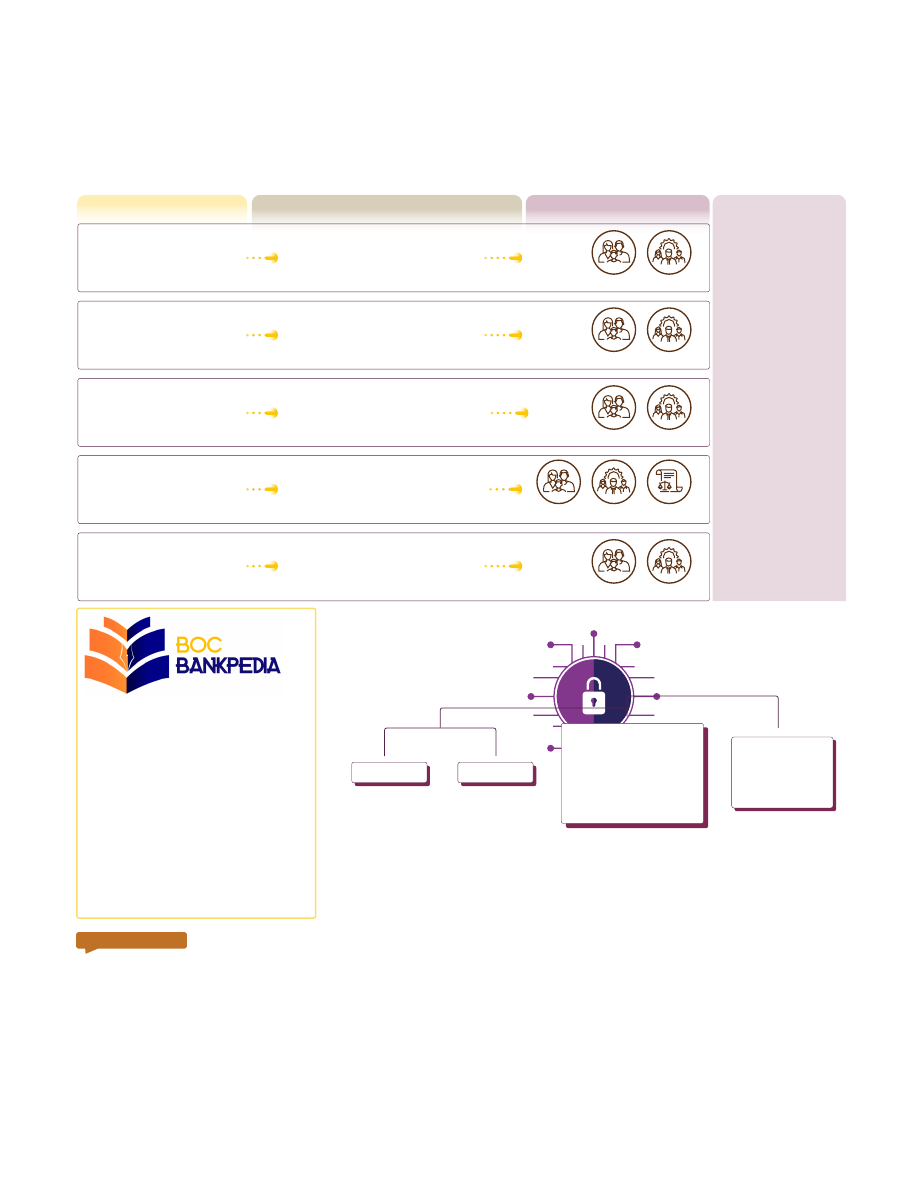
PROCESS
IMPROVEMENT
OUTCOME/S
IMPACTED STAKEHOLDERS
Streamlining
the incident
response process
Implementing Sri Lanka’s
first Software Defined Data
Center (SDDC) with VMWare
Automation of customer
related workflows
Automation of routine
security workflows
Upgrading the Oracle
Exadata Platform to the
latest version
Significantly reducing the
resolution time
Accommodating IFRS systems databases
Improving system performances
Reduction of licensing costs
Reduction in AC, power, space for
physical servers
Reduction of licensing costs
Improving system performances
Significant reduction of the time taken
for the processes
Maintaining a greater level of accuracy
Adhering to the internal and regulatory controls
Reduction in turnaround time
Customers
Customers
Customers
Customers
Customers
Employees
Employees
Employees
Employees
Employees
Regulators
3.9 million
Papers Saved
1,265
Toners saved
365,803
Fixed deposits opened
1.2 million
CASA opened
PRIORITY AREA 03:
STRENGTHENING SECURITY
The Bank has appointed a Data
Protection Officer (DPO) to oversee
compliance with the Data Protection
Act No. 9 of 2022. At present, the Data
Protection Officer functions under the
purview of the Chief Risk Officer.
BoC Bankpedia
The Bank further relies on E-learning
to drive organisational learning,
and accordingly introduced
BOC Bankpedia to serve as a
comprehensive knowledge bank.
BoC continues to build on its work-
from-home capabilities to ensure
business continuity and enhance
productivity even amid disruptions in
the environment.
The duties of the DPO at the Bank include overseeing the implementation and
enforcement of data privacy measures to comply with the Data Protection Act
in Sri Lanka. The DPO is actively involved in activities related to development of
comprehensive policies and procedures for data handling with the aim of ensuring
the secure handling of customer information. The DPO is additionally responsible for
providing ongoing training to staff on data protection practices to improve the data
protection posture of the Bank and conducts regular audits to assess compliance with
the requirements specified under the Act. Furthermore, the DPO plays a crucial role in
investigating and addressing any data breaches or privacy violations promptly, thereby
upholding trust, transparency, and confidentiality in the Bank's operations.
Owing to the increased threat with respect to cybersecurity and the Bank’s ongoing
alignment with the newly implemented Data Protection Act, the following steps
were taken in order to safeguard sensitive information and protect the organisation’s
stakeholders;
Security
Frameworks
at BoC
ISO 27001
ISO 27701
BoC Cyber Security
Framework developed
based on NIST Cyber
Security Framework on
Critical Infrastructure
Cyber Security
COBIT 2019
framework
(an ISACA
Framework)
57,749
Loans facilitated
OUTCOMES
OF PROCESSES
IMPROVEMENTS AND
COMPLETED WORKFLOWS

A DIGITALLY EMPOWERED BANK
Customer Privacy
GRI 418-1
No incidents of substantiated
complaints concerning breaches of
customer privacy took place during
2023.
No identified leaks, thefts or losses of
customer data took place during the
year.
Activity
Outcome
Deployed an advanced Data Leakage
Prevention (DLP) solution
Monitoring and preventing unauthorised
database access
Introducing a collaborative platform
Enabling real-time dissemination of
information among the security teams
Implementation of deception technologies Misleading and detecting any potential
attackers
Swift user separation through the
installation of firewalls
Enhancing data security
Implementation of advanced analytical
tools
Enabling proactive threat detection and fast
incident responses
WAY FORWARD
• Revamping UI/UX interfaces and the user experience across the Bank’s digital
platforms.
• Expanding on existing solutions and developing new products to serve corporate
customers.
• Developing a strong back-end to stabilise all core solutions and build an
integrated platform that incorporates the Bank’s key functions.
• Strengthening security utilising state-of-the-art firewall solutions, and conduct
continuous upgrades and developments in consultation with industry experts and
leaders.
• Utilising straight-through-processing and e-KYC to improve efficiency and
security.
• Leveraging AI and data analytics to drive process efficiency and customer service.
Leveraging AI
and data analytics
to drive process
efficiency and
customer service.
Implementing Best Practices,
Framework and Standards
As the Bank moves ahead in its
digitalisation journey, it has recognised
the value of IT, the management
of inherent risks and the need for
regulatory compliance. This requires
a comprehensive IT governance
model which consists of the necessary
leadership, organisational structure
and processes. IT governance is a
crucial aspect of its overall governance
framework, ensuring that technology
is effectively leveraged to support
business objectives while managing
risks appropriately.
The Bank’s ‘Enterprise IT Governance
Framework (COBIT 2019)’ includes the
following standards and best practices
which are to be implemented:
•
Quality Management Systems
(ISO 9001:2015 Standard)
•
Service Management System
(ISO 20000-1:2018 Standard)- IT
Infrastructure Library (ITIL) Best
practice
•
Risk Management (ISO 31000:2018
Standard)
•
Information Security Management
System (ISO 27001:2013 Standard)
•
Project Management Body
of Knowledge (PMBOK)
Effective IT governance requires
collaboration and coordination across
different functions, including senior
management, risk management,
compliance, and IT teams. It is a
continuous process of monitoring,
evaluating, and adapting to changes in
technology, regulatory landscapes and
business priorities.